After reading Nancy White's post A Few Flickr Flights of Fancy I got to thinking about what thousands of pictures are worth? Too much to think about? How about something more focused on a particular topic or population? After talking with the International District Housing Alliance's program manager for the Wilderness Inner-city Leadership Development Youth Program about the Community Perspectives Project, I started thinking about the power of photo sites like flickr for social, civic, and overall change.
To understand the thinking behind this, it probably helps to understand a bit more about the Community Perspectives Project. Briefly this project was to engage stakeholders of the International District (residents, youth, visitors, business owners, etc) in a dialogue about their perspectives of the neighborhood. The role of technology came into play through ComNET and Photovoice. ComNET stands for Computerized Neighborhood Environmental Tracking. Photovoice is a tool that gets cameras into the hands of people often left out of the decision making process. Surveys, focus groups and community presentations were also a component of this project. My main interest in this project centers on how they essentially repurposed the tech towards an engaging, social project. (I also think this is just a great idea in general)
Now does it make more sense about where I'm going with the whole flickr notion? The possibility that I see with Flickr has already been realized to an extent, given MoveOn's forray into this. I'd be curious to see what would happen if you take it a step further -- do something like Photovoice where the photographers collaborate, put their thoughts, visions and such into their own words and visuals. Have them go through a vetting process and the like to determine which is the best photo, and all. It's not so much about the tech, but how people interact with one another as supplemented by the tech. Have debates, have discussions about which photo should be selected for a wider viewing, or whatever else is appropriate. Really it's bringing people together, with the assistance of tech, and the end result of building community.
Another way of looking at this is how any photo sharing service plugged into a blog or something could be a new iteration of Photovoice or the family photo albums that users upload on the original Sims site? Not only would the groups who created the pics be able to share, but others can chime in with comments and all too. It becomes more of a dynamic conversation rather than static images. Images are powerful because of how they affect us as individuals and as a community.
Tuesday, January 24, 2006


Tuesday, January 17, 2006
oops...
it seems in my excitement around Benjamin Franklin's 300th birthday, I got a little excited and jumped the gun last week. oops. at least i get another chance to do good.
Turns out i didn't do any good that day anyway, at least not in the Benjamin Franklin sense. Today is looking better so far. Getting a project up and running to 1) find out what people would most like help with, and 2) pairing them up with folks in the community to help them. I know there are lots of sites that help with this already -- showing you your goals, people with similar goals, and also those who've done them. This is sort of in that vein, but smaller in scale, and more of a personalized touch to foster maximum interaction between the parties involved. Should be an interesting little experiment. I'll report back as things get going.
Later today, I'm also meeting with someone who ran a program connecting youth, tech and seniors in Seattle. Go here for a video summary of the project (real). More detailed description below:
Turns out i didn't do any good that day anyway, at least not in the Benjamin Franklin sense. Today is looking better so far. Getting a project up and running to 1) find out what people would most like help with, and 2) pairing them up with folks in the community to help them. I know there are lots of sites that help with this already -- showing you your goals, people with similar goals, and also those who've done them. This is sort of in that vein, but smaller in scale, and more of a personalized touch to foster maximum interaction between the parties involved. Should be an interesting little experiment. I'll report back as things get going.
Later today, I'm also meeting with someone who ran a program connecting youth, tech and seniors in Seattle. Go here for a video summary of the project (real). More detailed description below:
International District Housing Alliance Community Perspectives 6/27/2005
A story of how WILD (Wilderness Inner-city Leadership Development), a youth program within the International District Housing Alliance program has used technology and a partnership between local youth and elders to strengthen the voice of residents in the international District neighborhood. In an approximately thirty square block neighborhood where more than forty languages are spoken, historically it has been difficult for residents effectively speak for themselves in the larger City system. See how local youth and elders use photography, multi-language interviews, and Personal Desk Assistants to use diversity as an asset and work toward removing language as a barrier to democracy.
Monday, January 16, 2006
A Day On...
First off, I fully admit I've been a hypocrite today. As many in the US today recognized and celebrated the life of Dr. Martin Luther King Jr. with a day-on, I was at the office.
Regardless, I applaud everyone who is honoring King's legacy by volunteering in their community today. There can be no greater tribute for a man who not only worked towards civil rights in this country, but later on in his life saw the need to oppose the Vietnam War, and start a campaign against poverty. I'm not a historian, nor am I an expert in all things related to Dr. King, but to me his work seems to be that of love for this community we call humanity. Regardless of color, or social status, etc, his words and actions show an incredibly deep love the human family. By giving back to our local communities with a day on, you too can honor this legacy.
Some relevant links for today's MLK Jr. Celebrations:
Heed Dr. King's words, Atlanta mayor urges
Stanford University -- Articles by the Staff of the
King Papers Project
MLK Jr Speech, "I've Been to the Mountaintop" (text and mp3)
The King Center
I May Not Get There with You : The True Martin Luther King, Jr. reviews
Regardless, I applaud everyone who is honoring King's legacy by volunteering in their community today. There can be no greater tribute for a man who not only worked towards civil rights in this country, but later on in his life saw the need to oppose the Vietnam War, and start a campaign against poverty. I'm not a historian, nor am I an expert in all things related to Dr. King, but to me his work seems to be that of love for this community we call humanity. Regardless of color, or social status, etc, his words and actions show an incredibly deep love the human family. By giving back to our local communities with a day on, you too can honor this legacy.
Some relevant links for today's MLK Jr. Celebrations:
Heed Dr. King's words, Atlanta mayor urges
Stanford University -- Articles by the Staff of the
King Papers Project
MLK Jr Speech, "I've Been to the Mountaintop" (text and mp3)
The King Center
I May Not Get There with You : The True Martin Luther King, Jr. reviews
Tuesday, January 10, 2006
Happy Birthday Ben!
In the spirit of this space, I want to wish Benjamin Franklin a wonderful 300th birthday. While none of my accomplishments are even remotely on the scale of his, it is good to know that we both seem to have a passion for technology and civics. Here's an article from the Seattle Times talking about celebrations planned in his honor.
Also, I thought this was a nice little blurb about Benjamin Franklin and civics in general:
What good shall I do today?
Also, I thought this was a nice little blurb about Benjamin Franklin and civics in general:
Civic Visions tells the story of Franklin’s involvement with the founding of several key philanthropic, educational and civic institutions. From self-improvement, Franklin turned his attention to improving the community around him, asking himself, “What good shall I do this day.” Franklin, and a group of eleven working-class friends, known as the Junto were at the core of several Philadelphia institutions that were founded in the mid-18th century on behalf of the citizens of that city. Many of these institutions, such Pennsylvania Hospital and the University of Pennsylvania continue today, and the account of their founding will be told in this section, focusing on the universality of this group of new institutions— basic to any new, rapidly growing community.
from http://www.franklin300.com/exhibit.htm
What good shall I do today?
Wednesday, January 04, 2006
On the tip of my brain
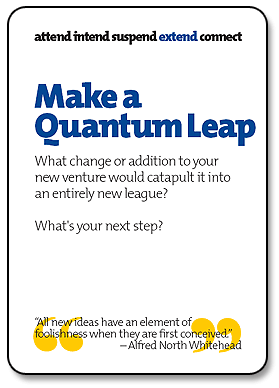
It's one of those times again when the forces that be are throwing things at me hoping I get an "A ha" moment. Whether or not this is the right "A ha" remains to be seen, but this broad notion of creativity is hitting me like a hammer lately.
First -- I've been reading The Big Moo ever since Jackie Huba and Ben McConnel sent me an unexpected copy of the book. Basically, the two of them along with 31 other thought leaders submitted essays on how to be remarkable. Many of the essays also focused on this notion of creativity.
Second -- Working with a casual game community, I can't help but follow happenings with community and games. ARGs is probably the best manifestation of this that insprires me to dream. In my opinion, play goes hand in hand with creativity. And with the growing influence of entertainment in day to day life, this sort of thing will be even more relevant.
Third -- The latest Fast Company has an article on something called Breakthrough Cafes. Some related information can be found at Idea Champions. This sounds a bit reminiscent of discussions I've had around the notion of Mind Camp, or some sort of conference a la the Pyramid-type events put on by Seattle Works.
So...all of those things coming together around the same time makes me wonder...how can I take it to the next level? There are certainly opportunities with Seattle Works, ACLF, or the Guiding Lights Network. And no doubt there are countless more opportunities. It's just a matter of focusing on a handful, be successful, and move from there.
Tuesday, January 03, 2006
Politics and Media
It's amazing what slight differences there are between Seattle and Vancouver, BC. The other week, my partner and were up there to get away for a few days. We met up with some of her friends from school and ate well as usual.
What was interesting about this trip was that it was in the middle of campaign season for Canada's government. I don't know if this only happens during elections, but I found it fascinating that while channel surfing late at night, I stumbled across a channel devoted to campaigns throughout the provinces called CPAC. Think of this as a mix between the History Channel, CSPAN and a cable news station. From a casual observation of the programming it was a mix of debates, features with potential voters, and candidate interviews. The reporters asked substantive questions and there was enough information to provide some historical context. Makes me wonder what something like this would look like in the States?
Also related to media and campaign coverage, while reading the paper in a cafe, I stumbled across an interesting assertion in The Globe and Mail (reg required):
What was interesting about this trip was that it was in the middle of campaign season for Canada's government. I don't know if this only happens during elections, but I found it fascinating that while channel surfing late at night, I stumbled across a channel devoted to campaigns throughout the provinces called CPAC. Think of this as a mix between the History Channel, CSPAN and a cable news station. From a casual observation of the programming it was a mix of debates, features with potential voters, and candidate interviews. The reporters asked substantive questions and there was enough information to provide some historical context. Makes me wonder what something like this would look like in the States?
Also related to media and campaign coverage, while reading the paper in a cafe, I stumbled across an interesting assertion in The Globe and Mail (reg required):
Internet blogs also seem to have less influence in an issues-based campaign. Blogs thrive in negative campaigns. They counter misleading statements by politicians, challenge party advertising messages and expose media manipulation, bias and errors. Highlights from their postings can end up influencing coverage in the mainstream media.Not following Canadian politics all that much, I can't speak to how accurate this statement is, though it does seem to make sense. That is, if a campaign or it's supporters aren't playing defense or offense the whole time, and instead focusing on the issues at hand, the tone of the conversation is vastly different. Now wouldn't that be novel!
So far, it seems there's less for blogs to chew over when policies dominate the campaign and media coverage.
All this suggests there's enough different in media coverage of the first half of this campaign that, if the parties focus on the negative in January, they may be surprised to find it less effective than in the past.
Monday, December 19, 2005
Consolidation can lead to consumer wins
It seems like the frenzy over AOL has finally ended with exclusive deals with Google and AOL. This isn't quite like the Googlezon as predicted in EPIC 2014 (and EPIC 2015)but it certainly bears watching.
Indeed, Wired has a recent article on Who's Afraid of Google? Everyone. Sure, much of this is probably competition, some likely has to jealousy...but suffice to say the landscape has changed dramatically from just a few years back.
I have no idea what the future holds, but as more companies like Microsoft introduce services like Live.com to better compete against Google, ultimately it seems that the end user wins. As more folks find tools that help amplify their voice, the better. As more folks find others with similar ideas, the better. The challenge will always be how do you balance empowerment, self-selection, community and a vibrant marketplace/diversity of ideas and voices?
Indeed, Wired has a recent article on Who's Afraid of Google? Everyone. Sure, much of this is probably competition, some likely has to jealousy...but suffice to say the landscape has changed dramatically from just a few years back.
I have no idea what the future holds, but as more companies like Microsoft introduce services like Live.com to better compete against Google, ultimately it seems that the end user wins. As more folks find tools that help amplify their voice, the better. As more folks find others with similar ideas, the better. The challenge will always be how do you balance empowerment, self-selection, community and a vibrant marketplace/diversity of ideas and voices?
Not ready for prime time -- wikipedia
Every once in a while -- I have to remember -- not everyone is online as much as I am. Lots of folks do not know the difference between a wiki and a blog. Likewise, many do not see what the fuss about podcasts and RSS is all about. By and large, these incredible tools still seem to be in the early adopter phase.
Sure, mainstream journalism is talking about this stuff a lot more. Go to any website for a major metro paper and you're likely to find some reference to a blog, feed, or even podcasts. Still doesn't mean the average person gets it, or knows what to do with it.
A prime example of this would be the whole hoopla over Wikipedia and the JFK assasination. To recap briefly, there was a prank done on wikipedia related to the JFK assassination. No one let the person indicted in the prank in on the joke, and they responded with an Op-Ed to the USA Today. Much controversy arose, many wrote about it, even Nature got into the fray.
This whole fuss reminds me of a previous post on wikis. Currently, it seems that wikis are best used in certain circumstances with the right expectations from all users/consumers. The LA Times experiment was a prime example of what can go wrong with a wiki, while Esquire seemed to do all right. Additionally, the whole Seigenthaler issue seems to be one of not really understanding what a wiki is, or can be.
Until a *much* broader segment of the users on the web understand what any of this stuff (wikis, blogs, etc) can do, I would not be surprised if more flare-ups such as this one occur again.
Sure, mainstream journalism is talking about this stuff a lot more. Go to any website for a major metro paper and you're likely to find some reference to a blog, feed, or even podcasts. Still doesn't mean the average person gets it, or knows what to do with it.
A prime example of this would be the whole hoopla over Wikipedia and the JFK assasination. To recap briefly, there was a prank done on wikipedia related to the JFK assassination. No one let the person indicted in the prank in on the joke, and they responded with an Op-Ed to the USA Today. Much controversy arose, many wrote about it, even Nature got into the fray.
This whole fuss reminds me of a previous post on wikis. Currently, it seems that wikis are best used in certain circumstances with the right expectations from all users/consumers. The LA Times experiment was a prime example of what can go wrong with a wiki, while Esquire seemed to do all right. Additionally, the whole Seigenthaler issue seems to be one of not really understanding what a wiki is, or can be.
Until a *much* broader segment of the users on the web understand what any of this stuff (wikis, blogs, etc) can do, I would not be surprised if more flare-ups such as this one occur again.
Thursday, December 08, 2005
Bowling Alone no more?
This may be a bit of a stretch regarding what most consider to be "technology” but it does relate to community and game play.
I was recently in a Barnes and Noble or Borders the other day and I was surprised to see an inordinate amount of games for sale alongside the best sellers. Sure, finding books on poker, crosswords and sudoku are to be expected, but actual board games such as Age of Empires or World of Warcraft (games that are traditionally computer / internet based games)? Not only that, but there were a lot of niche board games that I would only expect to read about on boardgamegeek.com All of this was rather unexpected. Of course, favorites such as Monoploy and Scrabble were readily found.
Maybe it's my naivety, or maybe it's been a long time since I set foot in a bookstore like that, but regardless, I think this is a good thing. Games are no doubt close to my heart -- perhaps more so after working with the casual game community for several years. There's something quite wonderful abut challenging oneself (in terms of things like crosswords and sudoku) and also about playing with others in games like chess, Monopoly or whatever.
A few years ago, Robert Putnam wrote about the decline of social capital in Bowling Alone. I don't know what the recent statistics are for bowling, but if the amount of games sold in stores is any indication, I would think that Putnam was wrong.
I was recently in a Barnes and Noble or Borders the other day and I was surprised to see an inordinate amount of games for sale alongside the best sellers. Sure, finding books on poker, crosswords and sudoku are to be expected, but actual board games such as Age of Empires or World of Warcraft (games that are traditionally computer / internet based games)? Not only that, but there were a lot of niche board games that I would only expect to read about on boardgamegeek.com All of this was rather unexpected. Of course, favorites such as Monoploy and Scrabble were readily found.
Maybe it's my naivety, or maybe it's been a long time since I set foot in a bookstore like that, but regardless, I think this is a good thing. Games are no doubt close to my heart -- perhaps more so after working with the casual game community for several years. There's something quite wonderful abut challenging oneself (in terms of things like crosswords and sudoku) and also about playing with others in games like chess, Monopoly or whatever.
A few years ago, Robert Putnam wrote about the decline of social capital in Bowling Alone. I don't know what the recent statistics are for bowling, but if the amount of games sold in stores is any indication, I would think that Putnam was wrong.
Monday, December 05, 2005
changing workforce demographics
As baby boomers begin to retire, and those in Gen Y enter the workforce, a whole variety of issues can manifest in the office. A few weeks ago, the USA Today did a story on Gen Y in the workforce. More recently, Business Week is getting into the game.
Loosely related, this reminds me of a recent conversation with a friend of mine who's worked with youth over the years. She discussed the ever changing role of tech -- how email is not too efficient in reaching youth, but IM and mobile phone use was. Also, we talked about some new studies looking at how people use their thumbs. For example, did you know that there's been studies showing that people are now favoring their thumbs when ringing a doorbell?
Seems to me that to really look at how tech and community intersect, I need to focus on what is going on with those still in middle school. (note to self, read Ito's research on mobile culture) Though they are already a force to be reckoned with, watch out when they take the international work/political/social world by storm.
out of the ordinary
I've been thinking about this topic for a bit -- this notion of surprise, and how what is unplanned can be a good thing in terms of community.
My first example would be at MindCamp and the lack of internet access. Though it was billed and planned as having a mesh network, things didn't work out as planned at first. Partly due to tech, partly due to lack of nodes in the mesh network, there just wasn't any connection at first. Though this did seem to put a hamper on things, I would argue that this fostered community because 1) people were forced to focus on the topics at hand 2) people had to interact with one another 3) you had an instant ice breaker of "gee, it sucks that there's no internet" 3a) shared, common experience. Apparently, others also believed the lack of access to the internet to be a good thing as evidenced by some feedback here on the wiki.
Another example of how the unexpected can be a good thing would be what happens in Seattle when it snows. First, it rarely snows, and if it does, it rarely sticks around. So it is not that surprising that people in this city get all "weird" when it comes to snow. For days the top news story was the snow. This overall weirdness though, is somewhat unique though. At work last week when it snowed, the focus of everyone in the office was elsewhere. People worried about how to get home, some had to get their kids from school, others looked in awe at the big fluffy flakes falling from the sky. Regardless of how individuals reacted, there was this overall giddiness in the office. Likewise, it seemed that there was this sense of wonder for all experiencing the snow. Just a few years ago when it did snow heavily and stay, the city of Seattle literally shut down. Hills turned into ski slopes. Neighborhood restaurants never looked so packed. The place down the corner from me turned into a ski chalet, offering free hot chocolate to those braving the weather.
In both scenarios, this notion of surprise and shared experience seems key in terms of bringing people together. It seems to shake people momentarily from their day to day routine, and we are all then able to look at the world with a sense of wonder, possibility and play.
My first example would be at MindCamp and the lack of internet access. Though it was billed and planned as having a mesh network, things didn't work out as planned at first. Partly due to tech, partly due to lack of nodes in the mesh network, there just wasn't any connection at first. Though this did seem to put a hamper on things, I would argue that this fostered community because 1) people were forced to focus on the topics at hand 2) people had to interact with one another 3) you had an instant ice breaker of "gee, it sucks that there's no internet" 3a) shared, common experience. Apparently, others also believed the lack of access to the internet to be a good thing as evidenced by some feedback here on the wiki.
Another example of how the unexpected can be a good thing would be what happens in Seattle when it snows. First, it rarely snows, and if it does, it rarely sticks around. So it is not that surprising that people in this city get all "weird" when it comes to snow. For days the top news story was the snow. This overall weirdness though, is somewhat unique though. At work last week when it snowed, the focus of everyone in the office was elsewhere. People worried about how to get home, some had to get their kids from school, others looked in awe at the big fluffy flakes falling from the sky. Regardless of how individuals reacted, there was this overall giddiness in the office. Likewise, it seemed that there was this sense of wonder for all experiencing the snow. Just a few years ago when it did snow heavily and stay, the city of Seattle literally shut down. Hills turned into ski slopes. Neighborhood restaurants never looked so packed. The place down the corner from me turned into a ski chalet, offering free hot chocolate to those braving the weather.
In both scenarios, this notion of surprise and shared experience seems key in terms of bringing people together. It seems to shake people momentarily from their day to day routine, and we are all then able to look at the world with a sense of wonder, possibility and play.
Wednesday, November 16, 2005
A new kind of philanthropy
This has been brewing for some time, but it seems that people are wanting much more of a hands on approach when it comes to philanthropy. This is clearly evidenced by all of the ad-hoc Katrina relief efforts that Nancy White documented, and now it's getting some nice play in the New York Times. As if that were not enough, NBC Nightly News did a story last night on a teacher inspiring kids to give back, not just through money, but with their own time and energy.
"the kids realize, dollar for dollar, their money is going to be spent where they intended — to buy cows"
This whole notion of getting more hands on, of directing and driving where the money goes specifically illustrates how much people want to get involved and give back. Going back to my MindCamp experience, people are wanting to work on citywide Wifi plans to democratize and empower people with information. Others are wanting to provide tech assistance to nonprofits. All of these are very hands on means by which a person gives back to the wider community. Indeed, it's a model not unlike Social Venture Partners where people who donate become partners in the organization and then help nonprofits with different projects.
This drive for more of a hands on approach to connecting with communities is interesting. In some ways, it seems to be a response to the cynicism that has pervaded previous generations in that it says, "Ok, we don't trust the institutions but we trust that we can do this ourselves, and possibly even better." Call it one part exuberance with one part entrepreneurship. No matter what you call it though, it is a very powerful mix.
"the kids realize, dollar for dollar, their money is going to be spent where they intended — to buy cows"
This whole notion of getting more hands on, of directing and driving where the money goes specifically illustrates how much people want to get involved and give back. Going back to my MindCamp experience, people are wanting to work on citywide Wifi plans to democratize and empower people with information. Others are wanting to provide tech assistance to nonprofits. All of these are very hands on means by which a person gives back to the wider community. Indeed, it's a model not unlike Social Venture Partners where people who donate become partners in the organization and then help nonprofits with different projects.
This drive for more of a hands on approach to connecting with communities is interesting. In some ways, it seems to be a response to the cynicism that has pervaded previous generations in that it says, "Ok, we don't trust the institutions but we trust that we can do this ourselves, and possibly even better." Call it one part exuberance with one part entrepreneurship. No matter what you call it though, it is a very powerful mix.
Implementation matters
OhmyNews has an article on "How Myspace.com Trumped Friendster" (via Influx Insights), underscoring the importance of implementation. In the case of MySpace and Friendster, here you had two services that were essentially the same. How each of them chose to implement their offerings varried, and ultimately determined their fates. It's interesting to think that in spite of the potential of Friendster, it basically came down to marketing, tapping into the most influential users, and nurturing that community. There, MySpace succeeded where Friendster failed.
Tuesday, November 08, 2005
Notes from (Mind) Camp
Hello Mother, Hello Father...greetings from (er, following) Mind Camp...
Yes, I was also a Mind Camp 1.0 attendee and participant. Several have already provided some nice summaries of the event (search for mindcamp1.0 tags at del.icio.us or technorati) so I won't dwell too much on them. It did intrigue me however that there seemed to be a great deal of folks interested in this broader notion of "community" or overall common good, through tech. If anything, that right there is worth the notion of holing up in an office building with 150 strangers for 24 hrs.
The first session I attended was on a discussion on the role of location based technology and community. Specifically, Kevin Moore from Microsoft wanted to know how to find interesting people with similar interests in a given area. Understandably, dodgeball, plazes, tribe, upcoming, tagging and city specific sites like Seattlest cropped up. The discussion then flowed to topics of data control, privacy, but also to what end do we want to use this information. Is it just for pure pleasure? Is it to help us have a better sense of who's around us by having a pseudo-bumper sticker of our interests and the like? Perhaps it's more purposeful than any of that by driving a community-driven marketplace for civic good, or combating our social dis-ease with one another. Or maybe, it's really a combination of all of this and other things not discussed like Playtime Inc or unimagined. At any rate, after the 45 minute session, I was intrigued at the possibilities for the rest of the event.
Later in the day, I pulled together a discussion on the role of game play, civics and technology. We started off the event with a round of Massively Multiplayer Thumb Wrestling just to get the energy flowing. What ensued after was a discussion that looked at flashmob-like events, the role of authenticity of message, organizations vs communities, reputation, surprise, play shifting expectations, and finding bridgers to connect otherwise unjoined networks...you know, just a few minor topics ;-)
Another session of note was Shelly Farnham's presentation on collaboration in the Katrina aftermath. Formerly of Microsoft Research, Shelly discussed the impact of Groove and the humanitarian relief efforts that followed Katrina in New Orleans. Some of the points focused on the intersection of the ad hoc and official relief groups, collaboration (or lack there of), and the *BIG* role of social capital were of special interest to me. The social capital aspect struck a chord with me; that people literally called those they personally knew for assistance to get something done was both exciting and sad at the same time. It's great that people connected with one another to get the assistance they needed. It's sad that the system failed to such an extent that people were left to fend for themselves. The question of how can technology help amplify the social networks of people with the end goal of assistance is a fabulous research direction. The role of helping to ensure those with limited social networks can also be effective is another key area in my book. Whether it's from the view point of those who need assistance and ensuring that they have the same opportunities and benefits as those with vast social networks, or whether it's from the standpoint of a relief worker who is new to the scene and needs to get something done...leveraging social networks for all is extremely important.
The other session that underscored community and the common good was wifi as a potential democratizing element. Korby Parnell and Jennifer Batten(?) talked of the possibilities of rolling out wifi in cities, partnering with libraries to essentially free information and overall help bridge the digital divide by making information and access more widely accessible. First, I love the concept, and I would personally like to have wifi wherever I go. I also love the intent of freeing more information, and helping people by getting information out there. However, I do not agree that these acts in and of themselves will make the divide disappear though. To me, providing the tools like wifi and access to solve social problems such as the digital divide is like saying providing a hammer and building materials will solve homelessness. Social problems facing our society, while they can certainly benefit from technology, cannot be solved by tech alone. Systematic issues as Nancy White raised, or the human factors as Liz Lawley pointed out, must be accounted for and built into the overall solution if we are to make headway on a rather complex social issue. I was a bit surprised at the level of defensiveness of some in the room at the notion that tech alone can't solve it, though at the same time, if one's experience is living proof of the bootstrap model, I can see how one might feel attacked by such an idea. Ultimately though, I was pleased that people are wanting to work towards solutions such as this. I am glad to know that there is this notion of common good and helping others in an increasingly fragmented world.
Aside from those sessions, it seemed others had this notion of connecting with others and helping people. For example, it was great to hear that folks like Kuang Chen and Alice Lin are also interested in using tech to help others in ways similar to NPower Seattle or OneNW. Through countless discussions with folks, it seems clear to me that there is this hunger for connection, for utilizing tech knowledge and expertise to help others, and simply put – community.
Overall it was a great conference. I liked the whole open space notion of it – you really get what you put into it. I met some wonderful people, and learned (unfortunately, after the fact) of more folks I'd like to talk with in greater detail. Thanks to the lock picking folks too -- great session. Now where do I get a kit? ;-) Anyway, I look forward to the next Mind Camp!
Yes, I was also a Mind Camp 1.0 attendee and participant. Several have already provided some nice summaries of the event (search for mindcamp1.0 tags at del.icio.us or technorati) so I won't dwell too much on them. It did intrigue me however that there seemed to be a great deal of folks interested in this broader notion of "community" or overall common good, through tech. If anything, that right there is worth the notion of holing up in an office building with 150 strangers for 24 hrs.
The first session I attended was on a discussion on the role of location based technology and community. Specifically, Kevin Moore from Microsoft wanted to know how to find interesting people with similar interests in a given area. Understandably, dodgeball, plazes, tribe, upcoming, tagging and city specific sites like Seattlest cropped up. The discussion then flowed to topics of data control, privacy, but also to what end do we want to use this information. Is it just for pure pleasure? Is it to help us have a better sense of who's around us by having a pseudo-bumper sticker of our interests and the like? Perhaps it's more purposeful than any of that by driving a community-driven marketplace for civic good, or combating our social dis-ease with one another. Or maybe, it's really a combination of all of this and other things not discussed like Playtime Inc or unimagined. At any rate, after the 45 minute session, I was intrigued at the possibilities for the rest of the event.
Later in the day, I pulled together a discussion on the role of game play, civics and technology. We started off the event with a round of Massively Multiplayer Thumb Wrestling just to get the energy flowing. What ensued after was a discussion that looked at flashmob-like events, the role of authenticity of message, organizations vs communities, reputation, surprise, play shifting expectations, and finding bridgers to connect otherwise unjoined networks...you know, just a few minor topics ;-)
Another session of note was Shelly Farnham's presentation on collaboration in the Katrina aftermath. Formerly of Microsoft Research, Shelly discussed the impact of Groove and the humanitarian relief efforts that followed Katrina in New Orleans. Some of the points focused on the intersection of the ad hoc and official relief groups, collaboration (or lack there of), and the *BIG* role of social capital were of special interest to me. The social capital aspect struck a chord with me; that people literally called those they personally knew for assistance to get something done was both exciting and sad at the same time. It's great that people connected with one another to get the assistance they needed. It's sad that the system failed to such an extent that people were left to fend for themselves. The question of how can technology help amplify the social networks of people with the end goal of assistance is a fabulous research direction. The role of helping to ensure those with limited social networks can also be effective is another key area in my book. Whether it's from the view point of those who need assistance and ensuring that they have the same opportunities and benefits as those with vast social networks, or whether it's from the standpoint of a relief worker who is new to the scene and needs to get something done...leveraging social networks for all is extremely important.
The other session that underscored community and the common good was wifi as a potential democratizing element. Korby Parnell and Jennifer Batten(?) talked of the possibilities of rolling out wifi in cities, partnering with libraries to essentially free information and overall help bridge the digital divide by making information and access more widely accessible. First, I love the concept, and I would personally like to have wifi wherever I go. I also love the intent of freeing more information, and helping people by getting information out there. However, I do not agree that these acts in and of themselves will make the divide disappear though. To me, providing the tools like wifi and access to solve social problems such as the digital divide is like saying providing a hammer and building materials will solve homelessness. Social problems facing our society, while they can certainly benefit from technology, cannot be solved by tech alone. Systematic issues as Nancy White raised, or the human factors as Liz Lawley pointed out, must be accounted for and built into the overall solution if we are to make headway on a rather complex social issue. I was a bit surprised at the level of defensiveness of some in the room at the notion that tech alone can't solve it, though at the same time, if one's experience is living proof of the bootstrap model, I can see how one might feel attacked by such an idea. Ultimately though, I was pleased that people are wanting to work towards solutions such as this. I am glad to know that there is this notion of common good and helping others in an increasingly fragmented world.
Aside from those sessions, it seemed others had this notion of connecting with others and helping people. For example, it was great to hear that folks like Kuang Chen and Alice Lin are also interested in using tech to help others in ways similar to NPower Seattle or OneNW. Through countless discussions with folks, it seems clear to me that there is this hunger for connection, for utilizing tech knowledge and expertise to help others, and simply put – community.
Overall it was a great conference. I liked the whole open space notion of it – you really get what you put into it. I met some wonderful people, and learned (unfortunately, after the fact) of more folks I'd like to talk with in greater detail. Thanks to the lock picking folks too -- great session. Now where do I get a kit? ;-) Anyway, I look forward to the next Mind Camp!
Wednesday, November 02, 2005
Community Design for Civics?
Jane McGonigal from Avant Game posted her ARG presentation from the Austin Game Conference.
In reading through the presentation, one particular item caught my attention:
That being the case, what can the civic realm learn about play, excitement, and creativity from ARGs?
In reading through the presentation, one particular item caught my attention:
Community design is the practice of creating new metaphors for collective experience in real life.Aside from a similar naming convention to Social Design, there's something quite intriguing about this notion. Something about ARGs has always left me with a sense of possibility. After all, here are collective experiences that actively engage people from all different points of view while fostering creativity, play and fun. You have the active participants, the teams (as applicable) the game makers and the passerby-ers. In many ways, this is not unlike the current political or civic realm in our local communities.
That being the case, what can the civic realm learn about play, excitement, and creativity from ARGs?
Beyond "clicktivism"
The other day, I wrote about online petitions. Related to that, there is this broader notion that some might call "clicktivism." While I haven't found a formal definition, let's just say for the sake of discussion this is some sort of web element that gets people more involved. Generally, users are encouraged to donate, write a letter, or sign a petition online.
While it has been proven that this form of engagement can be very effective in raising money, writing letters or signing a petition not much seems to be done to tie it to the local level.
Writing letters, donating, and contacting elected officials are just a few ways of getting involved in the civic arena. What about attending public meetings to speak about an issue as illustrated in Norman Rockwell's painting? Don't want to go alone? What about enlisting a friend or a new acquaintence that you met while volunteering at a local organization?Alternatively, you can even just connect with strangers and talk about it with others as in the Conversation Cafe or Meetup model. While the last two do not really involve direct action, it does connect people within a community and lays the foundation for action by virtue of illustrating that you are not alone in your interests, and beliefs. You can then turn around and get some of them to go to an event or public meeting, or you can work on a project like, such as those run by youth at DoSomething.org.
If you are like me and want something more tangible than clicktivism, I encourage you to try any of the suggestions above. I'd love to hear how it goes for you, and also any other suggestions people might have.
While it has been proven that this form of engagement can be very effective in raising money, writing letters or signing a petition not much seems to be done to tie it to the local level.
Writing letters, donating, and contacting elected officials are just a few ways of getting involved in the civic arena. What about attending public meetings to speak about an issue as illustrated in Norman Rockwell's painting? Don't want to go alone? What about enlisting a friend or a new acquaintence that you met while volunteering at a local organization?Alternatively, you can even just connect with strangers and talk about it with others as in the Conversation Cafe or Meetup model. While the last two do not really involve direct action, it does connect people within a community and lays the foundation for action by virtue of illustrating that you are not alone in your interests, and beliefs. You can then turn around and get some of them to go to an event or public meeting, or you can work on a project like, such as those run by youth at DoSomething.org.
If you are like me and want something more tangible than clicktivism, I encourage you to try any of the suggestions above. I'd love to hear how it goes for you, and also any other suggestions people might have.
Thursday, October 27, 2005
What is your pain point?
Amit Asaravala makes a great point about not buying into the hype of new techology when working with clients.
Take wikis for example, they do a lot of great things. But are they right for all clients? Just look at the difference between Esquire and the LA Times with regards to wikis.
Looking back, the key takeways from the wiki examples still ring true for me. I also would add that in addition to knowing "the pain points" one must also have keep the bigger picture in mind: institutional buy-in, a plan, and ongoing refinement.
The theme I keep arriving at over and over when I come across new Web 2.0 technologies -- or any new technologies for that matter -- is this: What is the problem I'm trying to solve in the first place?This is a great warning of keeping the bigger picture in mind when working with a client to meet their goals. Whether you're working with a business, nonprofit or other entity they all have particular goals they want accomplished -- they all have particular pain points to address. Don't throw tech at a problem and expect them to be all excited.
Take wikis for example, they do a lot of great things. But are they right for all clients? Just look at the difference between Esquire and the LA Times with regards to wikis.
Looking back, the key takeways from the wiki examples still ring true for me. I also would add that in addition to knowing "the pain points" one must also have keep the bigger picture in mind: institutional buy-in, a plan, and ongoing refinement.
Tech and the bigger picture
With all of the energy around new tech nowadays, it's important for all of us to remember that tech is only part of it. As with any tool, it's success is dependent on a variety of factors including:
As for tech being only so good as the plan, this is pretty basic. An organization might say, "I want to buy xbox 360s for everyone on my team." Well, unless there is a reason, cost justification, overall plan to use them in relation to the function of the job and the like, it's simply not going to fly.
Ongoing refinement. As anyone who has ever used technology knows, the second you buy it, there's a newer and better product on the market. This is not meant to say that you must always buy new tech (though upgrades should be part of the standard operating process), however, there needs to be someone, or a team of folks constantly evaluating the existing tech, what's out there on the horizon, and overall, trying to get the most out of what tech you do have as it relates to your work. In many ways, this step is essentially ongoing management; it stresses the importance of ensuring that the current goals are met, while evaluating what's out there to make things even better for you and the organization.
- the institutional buy-in driving the project
- the plan
- and ongoing refinement
As for tech being only so good as the plan, this is pretty basic. An organization might say, "I want to buy xbox 360s for everyone on my team." Well, unless there is a reason, cost justification, overall plan to use them in relation to the function of the job and the like, it's simply not going to fly.
Ongoing refinement. As anyone who has ever used technology knows, the second you buy it, there's a newer and better product on the market. This is not meant to say that you must always buy new tech (though upgrades should be part of the standard operating process), however, there needs to be someone, or a team of folks constantly evaluating the existing tech, what's out there on the horizon, and overall, trying to get the most out of what tech you do have as it relates to your work. In many ways, this step is essentially ongoing management; it stresses the importance of ensuring that the current goals are met, while evaluating what's out there to make things even better for you and the organization.
Saturday, October 22, 2005
the role of tv news and a democratic republic
Am I starting to sound shrill about this whole TV thing? I don't know. All I know is news portrayed on television is a powerful force. Here's a recent op-ed from the Seattle Times that talks of this. Also, here's a link to a speech that Edward R. Murrow gave in the 1950s that seems just as relevant today. Ok, I'm done now. Back to your regularly scheduled weekend.
web != boogeyman
I don't typically read Time Magazine (in print) nowadays. So imagine my surprise when I read about a neighboring city to the North in an article on fluoride.
Why even mention that here? Well, I was taken aback by this statement, "All this makes for a potent mix, especially when filtered through the Internet, where health-safety concerns tend to get amplified." Uhm, where did that come from? Yes, the chaff from the wheat is difficult to sort out on the internet, but then again, I would argue it's also true for other forms of communication. As to health-safety concerns getting amplified, doesn't just about everything get amplified if you shine a bright light on it? Perhaps that has something to do with that whole repetition, repetition, repetition thing?
At the very least, the article marginally redeems itself by saying how effective the web can be in terms of motivating people. You'll get no argument there.
Why even mention that here? Well, I was taken aback by this statement, "All this makes for a potent mix, especially when filtered through the Internet, where health-safety concerns tend to get amplified." Uhm, where did that come from? Yes, the chaff from the wheat is difficult to sort out on the internet, but then again, I would argue it's also true for other forms of communication. As to health-safety concerns getting amplified, doesn't just about everything get amplified if you shine a bright light on it? Perhaps that has something to do with that whole repetition, repetition, repetition thing?
At the very least, the article marginally redeems itself by saying how effective the web can be in terms of motivating people. You'll get no argument there.
Subscribe to:
Posts (Atom)

 Posts
Posts


